
CARDOPOLIS 48
IT'S ALL IN THE PREP

Happy New Year! Welcome to Cardopolis, a newsletter devoted to the history and craft of card magic with an occasional glance in the direction of mentalism. Cardopolis is published once a month, and a subscription gives you access to all the back issues, join in the comments discussions, and view hundreds of videos. If you’re not already a subscriber, you can join below. Subscription is $35 per year or $5 monthly.
It’s January, the perfect time to prepare a diary for Codex. The idea of a diary being used to reveal a selected card became popular following the release of Ted Danson’s It’s a Date (New Pentagram, March 1970), though there are precedents. There’s a complex card and birthday routine in Roterberg’s New Era Cards (1897). The diary described in Codex will be used for three different routines, the first of which is described in this issue. It’s the simple but puzzling prediction of a selected card.
We’ll also try something new in this issue of Cardopolis. I’ve included a link to a pdf that contains full instructions for constructing the diary. If it works, I’ll include pdfs in future issues that I think will be useful.
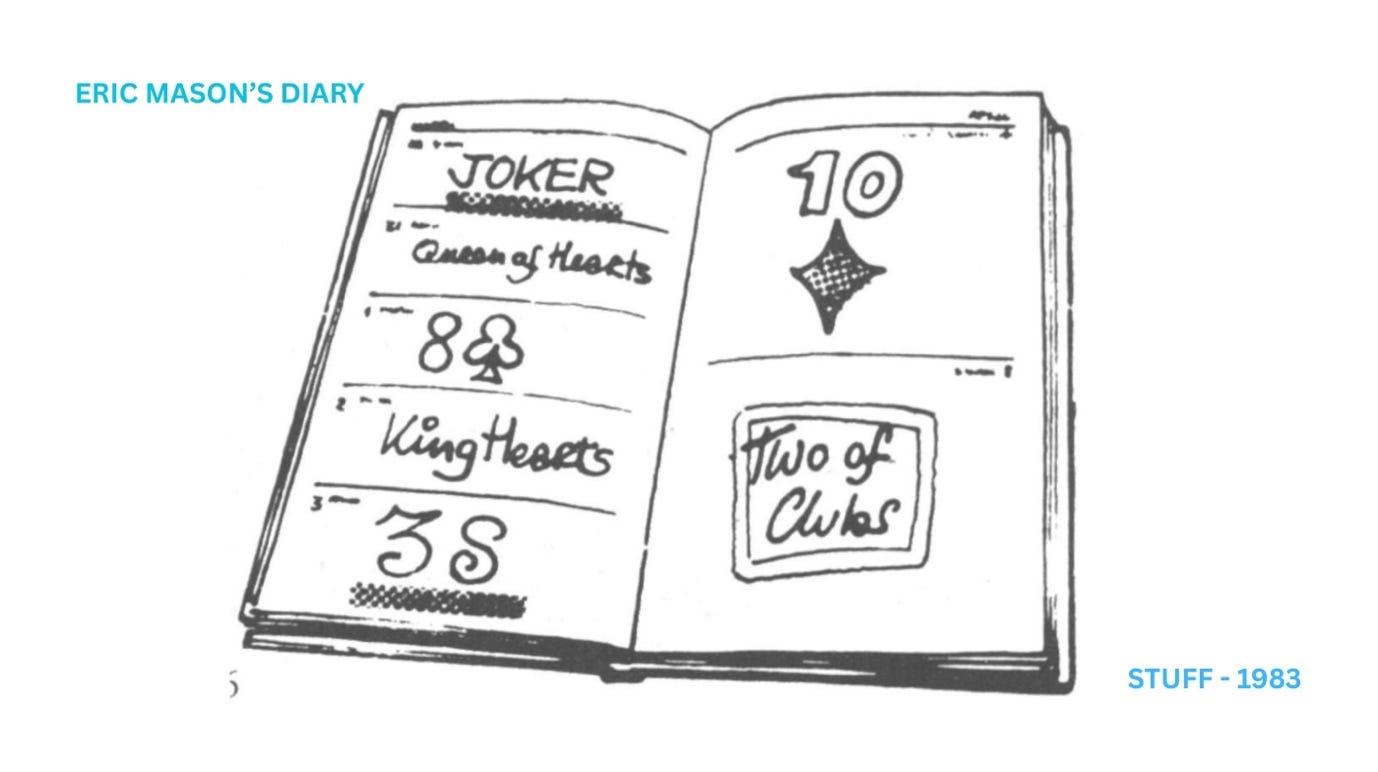
The other two routines using this diary will be in Cardopolis 49. There’s a bit of work and preparation involved but I think it’s worth it because you’ll be able to use it for many published diary effects. For example, Eric Mason’s Birthday Card in his book Stuff (1983).
Eric Mason was a professional artist, and his diary was inked with different colours and designs. Much more interesting than simply writing in the names of the cards. If you’re going to spend time on making the diary, think about how to make it an interesting object.
Trading Places builds on an idea of Jack Yates. Here you divine the location and identity of a selected card while the spectator mixes it among three other cards. All done while the performer has their back turned to the action. As a kicker you reveal the identities of the other cards, and which pockets the spectator put them in. A future issue will show how the principle can be adapted to use four borrowed objects.
Fribble Forecast is a trick based on a devious idea by Al Smith. Al came up with an unorthodox handling of a popular ruse, and it’s used here to predict which card will be chosen from a spectator-shuffled deck. It all looks very fair.
And we’ll be taking a look at Paul Daniels and The Eldanis in 1964. This was a surprise to me when I found it. I suspect it will surprise you too.
But let’s start with Lewis Ganson’s version of The Trick That Cannot Be Explained.
THE TRICK THAT CANNOT BE EXPLAINED
I believe it was at the Annual Easter Parade in 1978 that I saw Lewis Ganson perform The Trick That Cannot Be Explained. Ganson had made the plot famous when he wrote an account of Dai Vernon performing it in More Inner Secrets of Card Magic (1960). As he and Vernon were working on the book, Al Koran and Fred Lowe arrived and witnessed a trick that has since become legendary.
Vernon wrote a prediction on a packet of cigarettes which he placed writing side down on the table. Al Koran shuffled a deck of cards. When he’d finished, Vernon asked him to turn over the top card. It was the Six of Hearts. Then he asked Al to turn over the cigarette packet. Vernon had written ‘Six of Hearts.’ Koran said, ‘It was a knockout.’ The problem for Vernon was describing exactly how he did it because the outcome was improvised.
Which is why I was so astonished in 1978 when Ganson performed his version of the trick. Solid, direct, no improvisation. And simple to do.
I’ve changed the handling to make it a table trick, but the core method is all Ganson.